

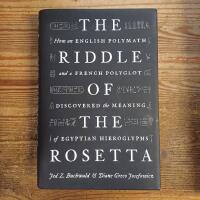
The Riddle of the Rosetta: How an English Polymath and a French Polyglot Discovered the Meaning of Egyptian Hieroglyphs
Inbunden bok. Princeton University Press. 2020. (xi) 561 sidor.
Nära nyskick. Skyddsomslag i nära nyskick. Text in English. Clothbound hardcover with a dust jacket. Illustrated with plates.
Inrikes enhetsfrakt Sverige: 62 SEK

Förlagsfakta
- ISBN
- 9780691200903
- Titel
- The riddle of the Rosetta - how an English polymath and a French polyglot discovered the meaning of Egyptian hieroglyphs
- Författare
- Buchwald, Jed Z.
- Förlag
- Princeton University Press
- Utgivningsår
- 2020
- Bandtyp
- Hardcover
- Mått
- 0 x 250 mm
- Språk
- English
- Baksidestext
- "In 1799, a French officer was clearing debris from a military installation when he discovered a stele bearing three scripts: ancient Greek, hieroglyphic, and a third that could not be definitively identified. This artifact, which came to be known as the Rosetta Stone, has traditionally played the starring role in the history of decipherment, which has until now been understood as an instance of code-breaking, a kind of Bletchley Park avant la lettre. In The Riddle of the Rosetta, Buchwald and Josefowicz delve into a wide array of British and French sources as well as archival material to produce a comprehensive new history of the decipherment. More than a puzzle-solving exercise based on a single artifact, the decipherment engaged with the era's social, cultural and intellectual contexts. It grew in the midst of heated disputes about language, historical evidence, the status of the Bible, the nature of polytheism, and the importance of classical learning. Jean-François Champollion in France and his British rival, the medical doctor and polymath Thomas Young, approached the decipherment from different standpoints derived from their contrasting temperaments, educational experiences, and attitudes to antiquity. Imbued with reverence for Greek culture and raised a Quaker, Young disdained Egyptian culture and saw Egyptian writing principally as a way to uncover new knowledge about Greco-Roman antiquity. To him, the decipherment was akin to a challenge posed by a problem in mathematics or science. Champollion's altogether different motivations and attitude unfolded amidst the political chaos of Restoration France, in fierce response to the intrigues of opposing scholars aligned with throne and altar. Unlike Young, Champollion admired ancient Egypt, and this sympathy, coupled with his willingness to upend conventional wisdom about the enigmatic Egyptian signs, freed him to travel a path down which Young refused to go. A remarkable intellectual adventure reaching from the filthy back streets of Georgian London to the hushed lecture rooms of the Institut de France, from the forgotten byways of provincial France to the splendor of the Valley of the Kings, this book reveals the decipherment in its full historical complexity"--
Princeton University Press
9780691200903





![Outbreak of the Peloponnesian War [Elektronisk resurs]](https://dez1v4fbcawql.cloudfront.net/metadata_thumb/978/080/149/9780801495564.jpg)